You Cannot Serve God and Money
Scripture: Matthew 5:5– 6:34, Luke 16:1–15
You Cannot Serve God and Money
In the name of Jesus. Amen. “No one can serve two masters, for either he will hate the one and love the other, or he will be devoted to the one and despise the other. You cannot serve God and money.” This is how our Gospel reading began this morning. Did this phrase sound familiar? If so, it might be because we heard this exact same teaching in the Gospel reading six weeks ago in Luke 16 with the parable of the dishonest manager. Isn’t that interesting? Matthew 6 and Luke 16 are the only places in Scripture where Jesus is recorded saying these words, yet they happen in very different contexts. Often times, the synoptic Gospels (that is, Matthew, Mark and Luke) will record the same events with slightly different perspectives. This is one instance, however, where Jesus seems to be giving the same teaching to convey two different messages. Now, just a warning today, I am going to be going back and forth between Matthew 6 and Luke 16 a few times today, so if you have your Bibles, you might find it helpful to have both of those chapters open for reference. Think back to the first time we heard this phrase six weeks ago. Jesus had just given the parable of the dishonest manager. In that parable, a manager discovers that his management is about to be taken away. Knowing that he will soon lose his income, he begins ingratiating himself with his master’s clients by dishonestly abrogating their debt. In doing so, he ensures that he has friends who will support him once his management ends. He is ultimately commended by his master for his shrewdness. Jesus concludes by telling his hearers, “make friends for yourselves by means of unrighteous wealth, so that when it fails they may receive you into the eternal dwellings.” While this is often considered one of Jesus’s more difficult parables, the message itself is straightforward. We are to be like the shrewd manager who knows his management is coming to an end. In our earthly life, most of us (all of us in this room) have enough money to live comfortable lives; our money supplies our daily bread. Like the employment of the shrewd manager, there will come a time when our money cannot help us any longer (the hour of our death). You can’t pay money to live a longer life. Thus, Jesus commands us to be like the shrewd manager who knows his support is coming to an end and plans accordingly. Like in the parable, we are to make arrangements such that we have an eternal dwelling prepared for us when the earthly one has passed away. When the parable is understood in this way, it is easy to see why Jesus concludes by saying “you cannot serve God and money.” There are many in the world who believe that their management (money) will support them forever. They do not concern themselves with thoughts about the afterlife; and why would they? Their money seemingly supplies their every need.
Money is indeed a good thing. It is required to secure many of the other good things that we need or that we enjoy, be it food, shelter, or various luxuries. As with all good things, when we have it, it makes us feel good. And there is nothing disordered about that in itself. It is natural to feel good when we possess good things. The contentment of possessing money becomes sin, however, when it moves us to neglect other more important spiritual goods. Thus, our contentment with money (and not just money, but all pleasures of this life) must be moderated by a virtue. In the context of Luke 16, that virtue is characterized as “shrewdness.” We must be forward-looking with an eternal perspective. We can’t let contentment with earthly goods cause us to think they are never-ending.
This brings us to an important point. Jesus isn’t only warning about money in this passage, but any earthly good in which you put your trust. If you go to our website, you will see that Pastor Brown’s sermon six weeks ago was entitled, “You cannot serve God and Mammon.” The translation we used today (the ESV) renders that same word “money,” but it is indeed the same Greek word used in both Luke 16 and Matthew 6: μαμωνᾷ. Mammon. If you look up Matthew 6:24 online, you will find that English translations are split about 50/50 between using the word “mammon” and the word “money.” The word “mammon” comes from either a Hebrew or Aramaic word which means “to trust.” Mammon is any physical thing in which we put our trust. You can see now why Jesus says “No one can serve two masters, for either he will hate the one and love the other, or he will be devoted to the one and despise the other. You cannot serve God and mammon.” Here, Jesus is not giving a command that we should not serve both God and money, but rather he is making a factual claim that we cannot serve both God and money. It is impossible. And now that we understand what the word “mammon” means, we see why. If someone is putting their trust in physical things, then they are not putting their trust in God. No one can serve two masters. You cannot serve God and money, or God and your house, or God and your luxury items. All of these things fall under the category of mammon.
Now back to our story in Luke 16. The text says, “The Pharisees, who were lovers of money, heard all these things, and they ridiculed him.” They simply could not imagine that their management would end. They were lovers of mammon. Their contentment was in their money (not God), and it contributed to their spiritual blindness.
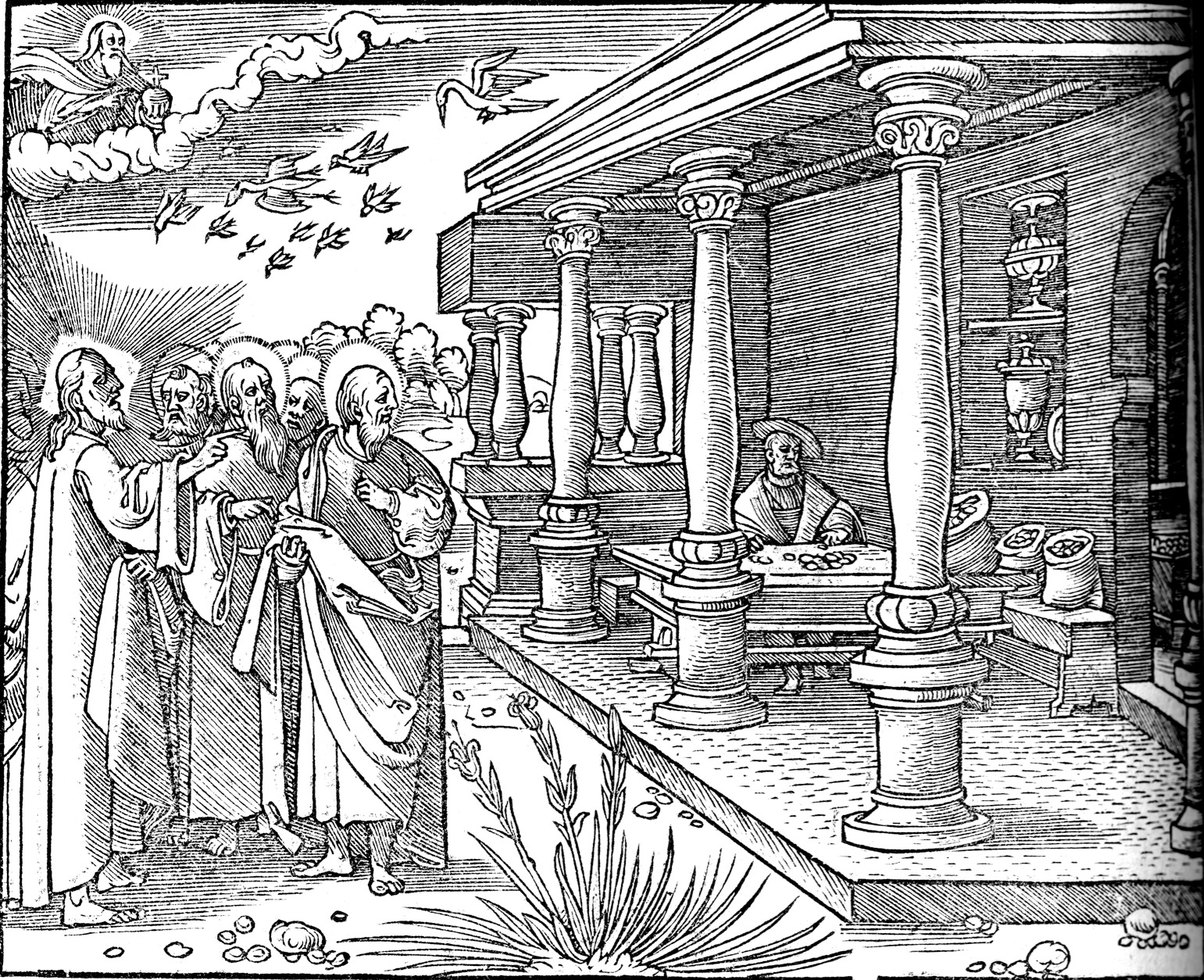
Now, enough about Luke 16. Let’s turn back to this week’s Gospel lesson. As I mentioned, there are two instances in the Gospels where Jesus tells his hearers that they cannot serve God and money. We just talked about the first one in Luke 16:13, where Jesus condemns the disordered contentment that can accompany attaining wealth. The second is in Matthew 6:24, where Jesus uses the same phrase to preface his teachings on the universal provision of all creation. The text we heard this morning says: “You cannot serve God and Mammon. Therefore I tell you, do not be anxious about your life, what you will eat or what you will drink, nor about your body, what you will put on. Is not life more than food, and the body more than clothing? Look at the birds of the air: they neither sow nor reap nor gather into barns, and yet your heavenly Father feeds them. Are you not of more value than they? And which of you by being anxious can add a single hour to his span of life? And why are you anxious about clothing? Consider the lilies of the field, how they grow: they neither toil nor spin, yet I tell you, even Solomon in all his glory was not arrayed like one of these. But if God so clothes the grass of the field, which today is alive and tomorrow is thrown into the oven, will he not much more clothe you, O you of little faith?” Do you see the connection? Do you see the “therefore”? Food, drink, clothes: all these things are mammon if you put your trust in them. That is the point Jesus is making here.
And now we see how different the context is between Matthew 6 and Luke 16. While the parable of the dishonest manager concerns people who are content in their wealth, Matthew 6 addresses people who worry about not having enough money. Luke 16 is about abundance, but Matthew 6 is about scarcity. And the sad part is, in our sinfulness, most of us probably regularly fall into both traps. We worry. “What would I do if I lost my job? What if someone in our family gets seriously sick? Would we be able to afford the medical bill? Have I really saved enough to retire? Do we have enough in savings?” Even in our abundance, we are constantly afraid of need. We worry that we simply don’t have enough money. And in those moments, how easy it is to trust in mammon rather than God.
At the same time, in the moments when we aren’t thinking about our hypothetical needs, we imagine ourselves secure in our possessions. “Our 401K is doing great! Our house is worth a small fortune! We’ve got that six-figure salary!” To use the words of Luke 16, we imagine that our management will never end. We become fixated on the things of this life. We don’t think about the friends we will need to welcome us into that eternal dwelling. When you’re doing well it’s so easy to imagine that you don’t need anyone but yourself to supply your daily bread. And this is the beauty and genius of Matthew 6. Do you know what comes right before today’s Gospel lesson? “Do not be like [the Gentiles], for your Father knows what you need before you ask him. Pray then like this:” and then Jesus gives us the Lord’s prayer, including the petition “give us this day our daily bread.”
The remedy to the sin of both the worrier in Matthew 6 and the money-loving Pharisee in Luke 16 is to trust that God gives you what you need. In other words, the remedy is faith. The money-loving Pharisees rejected Jesus’s parable of the shrewd manager because they imagined that their wealth would sustain them in every need. How does Jesus respond to them? “You are those who justify yourselves before men, but God knows your hearts. For what is exalted among men is an abomination in the sight of God.” Jesus is here teaching the importance of recognizing that the things exalted among men (riches) count nothing in the sight of God. In other words, there is a priority of importance placed on spiritual goods over temporal goods. This priority is recognized through faith, a firm trust in what Jesus is here teaching.
Similarly, Jesus concludes his teaching on anxiety in Matthew 6 by commanding his hearers to “seek first his kingdom and his righteousness, and all these things will be given to you as well.” In other words, those that seek the Kingdom of God (spiritual goods) first will have their daily needs (temporal goods) met by Him. In order to have a right relationship with money, you must first recognize that God is the one to whom you look for provision, not temporal goods. When we seek our true spiritual good (namely God) first, our earthly needs will also be supplied. This same teaching is exemplified in the Lord’s prayer a few verses prior. We are to first pray that God’s name is hallowed and His kingdom come, and then we ask for our daily bread. When we seek first the kingdom, all earthly needs will be added unto us also.
And this is where the good news comes in. Yes, Matthew 6 does indeed teach us something about how we are supposed to relate to money. There is certainly a law component here. But we also must receive God’s good and gracious promises in this text. The reason that we are not to have anxiety over money is because God has promised to give us what we need. We do not put our faith in mammon, as the pharisees did. We have something much more powerful and certain than that. How silly would it be to put our trust in money when you have a heavenly Father who has promised to give you everything you need? “For the Gentiles seek after all these things, and your heavenly Father knows that you need them all.” We serve an all-powerful, all-knowing, and all-loving God. He knows exactly what you need and is eager to give it to you. So entrust your cares to the same God that feeds the birds and clothes the lilies. Indeed, you are much more valuable in your Father’s sight then they. Just as he provides for all creation, he will all the more provide for you. Amen.
The peace of God, which passes all understanding, keep your hearts and minds in Christ Jesus.