Do not weep
Scripture: Luke 7:11–17
Do not weep
Scripture Lessons
1 Kings 17:17-24
Psalm 30
Ephesians 3:13-21
Luke 7:11-17
Grace to you and peace from God our Father and the Lord Jesus Christ.
“Be gracious to me, O Lord, for to you do I cry all the day. For you, O Lord, are good and forgiving, abounding in steadfast love to all who call upon you. Incline your ear, O Lord, and answer me, for I am poor and needy. In the day of my trouble I call upon you, for you answer me.” Psalm 86, Introit for Trinity16. This excerpt from Psalm 86 was part of the Introit we sang today. The question is, do you call upon God as we profess in the Psalm? Do you ask God to incline His ear to hear you? Do you confess your poor and needy condition? And do you trust that He will answer you in your day of trouble, when you call upon Him?
Your faith is under attack. Sin is all around us. We see death and sickness. We suffer and when we do, we feel our mortality. Peter warned, “Be sober-minded; be watchful. Your adversary the devil prowls around like a roaring lion, seeking someone to devour.” 1 Peter 5:8. Satan’s goal is to devour your faith. His greatest advantage comes in two ways. First, when you have all that you need. And secondly, when you are in despair. When you have enough to eat, a warm home, everyone’s doing well, etc., you can too easily become complacent and forget to thank, praise, serve, and obey God. On the other hand, when the chips are down and things aren’t going well, you may become angry with God for allowing you to suffer such hardship. You may blame God for your circumstances or at least feel like God doesn’t love you. Whether times are good or bad, you can rest assured that God loves you and that Satan wants to rip you away from that love.
The lesson from 1 Kings, in which the great prophet, Elijah, raised a widow’s son to life has many parallels to the gospel lesson from Luke 7, in which Jesus raised the widow’s son. When you think about these historical accounts, recognize that neither lesson is intended to eradicate the imminent consequence of sin, that is death. After all, both of these widow’s sons are dead, as are the widows themselves. They were raised from the dead, but it was not a resurrection like Jesus’ resurrection…not yet. These lessons are not intended to convey to the faithful a guarantee that your loved ones will never die. In fact, we will all die unless the Lord returns first.
As is the case with the entirety of the Old Testament, these accounts are significant events that point to something of even greater significance. What could be greater than your dead son being restored to life? Christians know the answer…you’re son being raised to life everlasting! So, let’s look at the gospel lesson more closely.
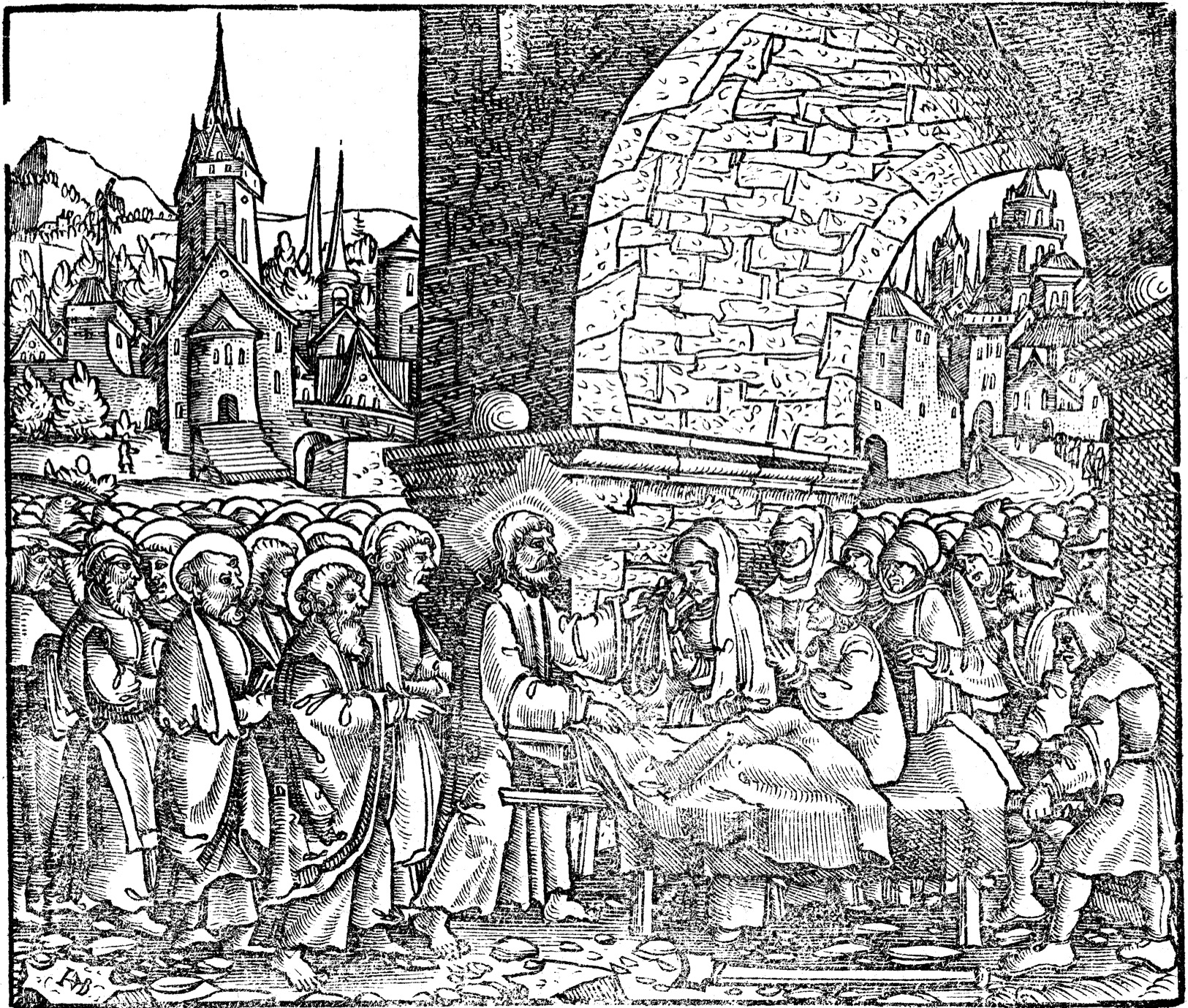
Jesus had compassion on the woman. This means, He felt her pain in his guts (σπλαγχνιζωμαι). When Jesus met the widow of Nain, He brought immediate consolation by raising her son. She was a widow. He was her only-begotten son. There was a considerable crowd mourning with her and having pity on her. Jesus had compassion. He touched the bier! This would make a person ceremonially unclean! But His compassion means that He will touch the unclean. If you feel unclean, filthy with sin, you may be assured that He is not afraid to come near you. “though your sins are like scarlet, they shall be as white as snow.” Isaiah 1:18. Jesus is one who comes to the unclean and touches the dead. When this happened, those who were carrying the bier stopped. Jesus said, “Young man, I say to you arise.” This is the word and command of Jesus. He commanded resurrection and His word carries with it the power to accomplish what He says. Thus, the dead man sat up and began to speak. “And Jesus gave him to his mother.” He told the widow not to weep and now He delivered on the implicit promise of consolation. “Here is your son.”
But Jesus did not provide only imminent consolation in this act of mercy. He provided permanent consolation to her just as He continues to bring this consolation to you this very day. This is a resurrection which points forward to the resurrection of Christ Himself. Christ’s resurrection demonstrates once and for all the power that God has over death. Paul concluded 1 Corinthians, “When the perishable puts on the imperishable, and the mortal puts on immortality, then shall come to pass the saying that is written: ‘Death is swallowed up in victory. O death, where is your victory? O death, where is your sting?’ The sting of death is sin, and the power of sin is the law. But thanks be to God, who gives us the victory through our Lord Jesus Christ.” 1 Corinthians 15:54-57.
The people present for this miracle, which was a large crowd, were seized with fear. They glorified God but attributed this work to a great prophet of God, not recognizing that Jesus is God incarnate. They were observing these things prior to the resurrection of Jesus. On the other hand, we are observing these things knowing that Jesus Christ is the one who was raised for our justification. He has defeated sin, death, and the devil.
Jesus raising of the widow’s son provides lasting and permanent consolation to all poor and needy sinners. Because we see in this act of mercy both His power over death and His great compassion. It’s not enough that God is powerful to save. But what is added is that God’s will is that you be saved. For this reason He has washed you in the waters of baptism and given you the gift of the Holy Spirit. He feeds you with His very body and blood at this altar that you may know that He has compassion and mercy on you. Whatever hardships you are facing, hear Jesus’ words to the widow of Nain, “Do not weep.” Rather, receive the consolation of Christ.
The peace of God, which passes all understanding, keep your hearts and minds in Christ Jesus.” Amen.