Putting On Christ
Scripture: Matthew 22:1–14
In the name of Jesus. Amen. The lectionary provides two options for the Gospel reading today, and both narratives occur at about the same time and in the same context. Both readings also prominently feature parables; and while the parables themselves are quite different, the themes are very similar. The first option (the reading I didn’t pick) is the end of Matthew chapter 21, where Jesus gives the parable of the tenants to the chief priests and Pharisees. In that parable, Jesus describes a landowner who plants a vineyard, equips it for producing wine, and leases it to tenants before departing. When he sends his servants to collect the fruits of the vineyard, the tenants beat, stone, and kill them. Finally, the landowner sends his son, expecting the tenants to respect him, but they kill him as well in an attempt to seize his inheritance. Jesus concludes that parable by explaining that the landowner will bring those wicked tenants to judgment and entrust the vineyard to others who will produce its fruits.
In case there was any doubt who this parable is about, verse 45 gives us a definitive answer: “When the chief priests and the Pharisees heard his parables, they perceived that he was speaking about them.” And they were right! Jesus is specifically addressing this parable to the Jewish religious leaders. Our Gospel reading today picks up immediately after the conclusion of this parable. The first verse in our reading tells us that Jesus is once again speaking to the Pharisees and chief priests. He tells them: “The kingdom of heaven may be compared to a king who gave a wedding feast for his son, and sent his servants to call those who were invited to the wedding feast, but they would not come. Again he sent other servants, saying, ‘Tell those who are invited, “See, I have prepared my dinner, my oxen and my fat calves have been slaughtered, and everything is ready. Come to the wedding feast.”’ But they paid no attention and went off, one to his farm, another to his business, while the rest seized his servants, treated them shamefully, and killed them. The king was angry, and he sent his troops and destroyed those murderers and burned their city.” There is a lot to unpack here, but given the context I just described, you can probably identify the main parties in this parable. The King who hosts the wedding feast is God, and the King’s son is Jesus. No difficulties so far. The next group mentioned in the parable is the King’s servants. These are the ones who went out into the city to call those who were invited to the feast. Now who might the servants represent, and who are the ones who were invited to the king’s feast? In this context, it seems that Israel corresponds to the group that was invited to the feast, and that would make Israel’s prophets the servants. Remember how Israel is repeatedly described in the book of Deuteronomy: “For you are a people holy to the Lord your God. The Lord your God has chosen you to be a people for his treasured possession, out of all the peoples who are on the face of the earth.” The ancient Israelites had a special relationship with God. God made specific covenants with Israel and gave them a unique set of ceremonial and civil laws that made them distinct from all other people groups. They, indeed, had a specific invitation to the wedding feast of the King. And this invitation was constantly being extended and reiterated through the prophets. The prophetic message was made most clear from the last and greatest prophet, John the Baptist, as he cried “Repent, for the kingdom of heaven is at hand,” and more importantly, “Behold, the Lamb of God, who takes away the sin of the world!” Prophets like John the Baptist were indeed calling Israel, the invited guests, to come to the marriage feast of the Lamb. But, for the most part, what was Israel’s response? As verse three says, “they would not come.” But the King, being abundant in grace, did not give up on his guests. After their first refusal, he sent “other servants” to once again tell them that everything is prepared and waiting for them. This time, not only did they not come, but they turned to their worldly goods, and some even killed the servants the king had sent. In case you need even more confirmation that the servants represent the prophets and invited guests represent Israel, do you remember how Jesus describes Jerusalem in Matthew 23, which is the chapter immediately after this reading? “O Jerusalem, Jerusalem, the city that kills the prophets and stones those who are sent to it!” This is even further confirmed by what happens next in the parable. After His servants were killed, our reading says that “The king was angry, and he sent his troops and destroyed those murderers and burned their city.” This is probably the most prophetic utterance in any of Jesus’s parables. About 40 years after Jesus told the Jewish religious leaders this parable, Jerusalem would be completely burned to the ground by the Romans, and the population of Jerusalem would be utterly decimated. Is that not astounding? After specifically identifying Jerusalem as the city that kills its prophets, the ones identified as “servants” in the parable, he casually tells them, with perfect accuracy, what their judgement will be. And it came to pass exactly as He said. The city was burned, and the murderers were destroyed.
So, as it turned out, the invited guests were not worthy of the banquet. Not because they lacked good works, but because they refused the gracious invitation. But the King was not going to let this tragedy go unredeemed. Though the invited guests refused, there was another solution to fill His great banquet hall. He sent out His servants once more, this time not to call on the invited guests, but to issue a new invitation to anyone and everyone. Our text says, “And those servants went out into the roads and gathered all whom they found, both bad and good.” This is probably the most profound line in the entire parable. The third time the servants were dispatched, they extended an invitation not only to those “good” citizens who might normally be deemed worthy of such a royal occasion, but also to the “bad,” those who are totally unworthy to be in the presence of royalty. At this point, you might be asking how this distinction between “the good and the bad” fits with what Scripture teaches elsewhere. Isn’t everyone “bad”? Doesn’t Paul say that “None is righteous, no, not one” and “no one does good, not even one” in Romans 3? Yes, he does indeed. That is the same place he tells us that all have fallen short of the Glory of God. In the eyes of God, we are all condemned by our sin, and that is the sense in which Paul is speaking. In this parable, Jesus is speaking not of “goodness” or “badness” in the eyes of God, but rather the eyes of man. We do this all the time. We say “he is a good guy” or “she is an excellent mother.” We know what we mean when we talk this way. We don’t mean that these people are righteous of themselves in the eyes of God, but rather that they possess some measure of worldly virtue, or that their lives are rightly ordered in some way. Jesus talks this way also. In Matthew 21:31, why did Jesus tell the Pharisees that “the tax collectors and the prostitutes go into the kingdom of God before you?” He was using those people as examples of groups that society would deem “bad” in distinction with the “good” teachers of the law. The religious leaders are perceived as being virtuous, and these other groups are seen as being unrighteous. This is the distinction between the “good” and the “bad” in our parable. In other words, the invitation to the wedding feast was extended not only to upstanding citizens or nobility, but also to the prostitutes and tax collectors!
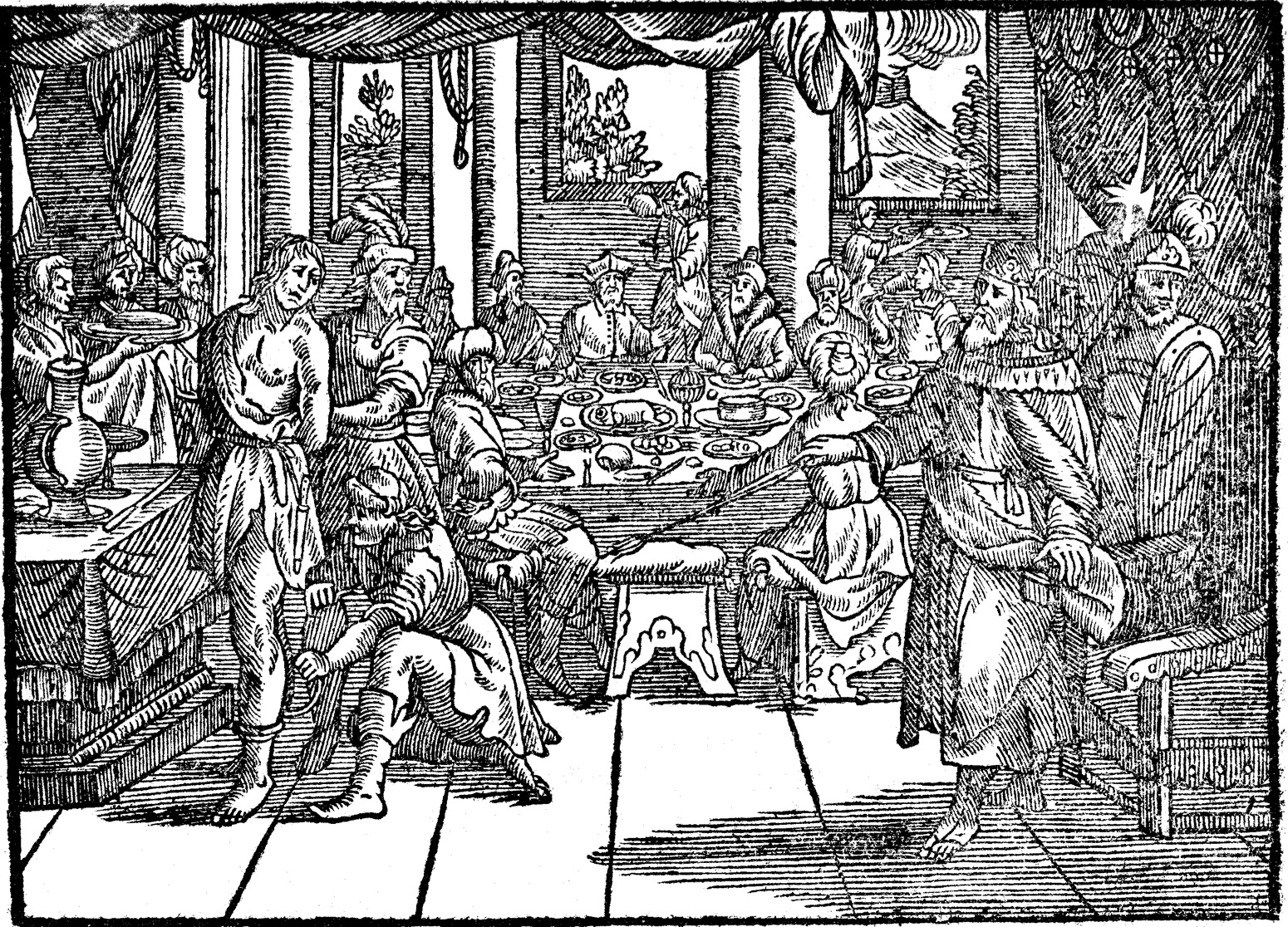
We move on now to the conclusion of the parable. Our text says that the wedding hall was filled with guests. Apparently, many of those who were initially not invited accepted this subsequent invitation! But, as we soon find out, there is an expectation of those who accept the invitation to the banquet. Those invited are given a gift- a wedding garment- that they must wear to the festivities. The garment is not a product of their own labor; the guests are not expected to provide their own garments, as we shall see. They are a free gift from the King himself. They must, however, put on the garment if they will attend the feast. One man failed to do this very thing, and we are told the consequences: “Then the king said to the attendants, ‘Bind him hand and foot and cast him into the outer darkness. In that place there will be weeping and gnashing of teeth.’” This might seem to us like a harsh punishment. The man was excluded from the feast on account of his clothing? Where is the justice in that? But imagine the situation the parable describes: a man, possibly a lying, cheating, tax collector, the lowest of the low in society, is given an invitation to a royal wedding. He has no business being anywhere in polite society, and certainly not at a royal feast. The only stipulation is that he must wear the garment provided to him by the king. Who would have the audacity to refuse the garment? There is simply no excuse. You didn’t have to pay for these garments; they were freely given by the King, at his own expense. To refuse to wear the garment is to spit in the face of the one who graciously invited you.
The parable ends with a seemingly ominous phrase. “For many are called, but few are chosen.” What do we make of this? Who are those that are called, and who are those that are chosen? Let’s return to the parable to answer that question. The “many” who are called are all those who receive the invitation to the wedding feast, “both bad and good.” In other words, these people are anyone and everyone who has heard the Gospel invitation. As we well know, not everyone who receives the invitation attends the banquet. In other words, you can share the Gospel with someone, and they may well reject it. But some who hear the invitation do go to the wedding feast. These few among the many invited are the “chosen” ones. And if you want to know why they are called “chosen,” you will need to listen to our Bible study on election and predestination from three weeks ago.
The most pressing question here, of course, is how do you know that you are one of the few chosen rather than merely the many who are called? This is the question that might keep you up at night. For this question, too, we return to the parable. The “chosen” at the wedding feast, namely the ones who participated in the feast worthily and were accepted, are all those who were clothed in the garments of the King. We have already said that individual merit does not play a role in this equation; both the bad and the good were invited, and people of each group donned their wedding garments to attend. The prostitute who clothed herself in the wedding garments fed sumptuously at the wedding feast and was filled. The only ones the King found wanting were those who were not wearing His garments.
Have you ever noticed how Scripture talks about Christ as if he is something we “put on” like a garment? I don’t think that’s a coincidence. Romans 13:14 says, “But put on the Lord Jesus Christ, and make no provision for the flesh, to gratify its desires.” Similarly, Galatians 3:27 says, “For as many of you as were baptized into Christ have put on Christ.” This (the baptismal font), is where you become clothed in Christ, according to St. Paul. This is where you put on your wedding garments. And just like in the parable, to put on Christ in baptism is a free gift. It isn’t something you earn, or work for, or pay for. It is something you are given. And as long as you are clothed in Christ, you are a worthy guest at the wedding feast of the Lamb. That is all that it takes to be among the “chosen.” If you are clothed in The Son, you will not be rejected by the King. This is why we Lutherans are always talking about baptism. If you’re ever concerned that you aren’t among the few chosen, you think back to what happened here. This is where you were clothed in Christ, and it is that fact, not your works, not your deeds, not your efforts that makes you a worthy guest at the feast.
Since we’re going through the book of Revelation in our Bible study, let’s close with this fitting reading from Revelation Chapter 7: “After this I looked, and behold, a great multitude that no one could number, from every nation, from all tribes and peoples and languages, standing before the throne and before the Lamb, clothed in white robes, with palm branches in their hands, and crying out with a loud voice, “Salvation belongs to our God who sits on the throne, and to the Lamb!” And all the angels were standing around the throne and around the elders and the four living creatures, and they fell on their faces before the throne and worshiped God, saying, “Amen! Blessing and glory and wisdom and thanksgiving and honor and power and might be to our God forever and ever! Amen.” Then one of the elders addressed me, saying, “Who are these, clothed in white robes, and from where have they come?” I said to him, “Sir, you know.” And he said to me, “These are the ones coming out of the great tribulation. They have washed their robes and made them white in the blood of the Lamb.”
You have put on Christ. You have washed your robes in the blood of the lamb, and on that account, you are a partaker not only in the blessed feast we will celebrate here in a few minutes, but also in the eternal wedding feast of which this feast foreshadows. So come to this table with the assurance that you are a worthy guest because you are clothed in the wedding garments of Christ, and leave here with the assurance that this same garment will also avail at the eternal wedding feast of the Lamb. Blessing and glory and wisdom and thanksgiving and honor and power and might be to our God forever and ever! Amen.
The peace of God, which passes all understanding, keep your hearts and minds in Christ Jesus.