And So We Are
Scripture: 1 John 3:1–3
And So We Are
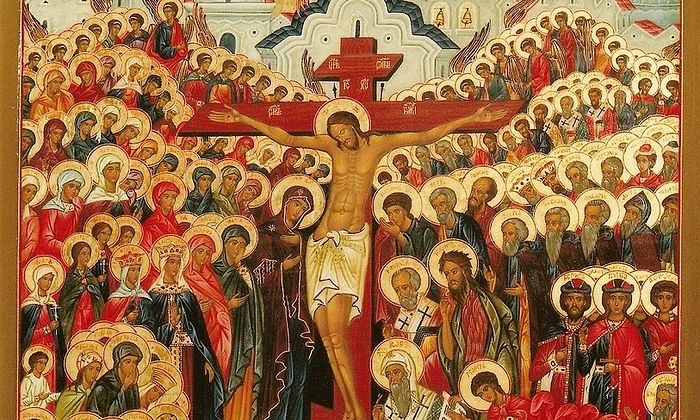
In the name of Jesus. Amen. Today is All Saint’s Day, which is the day we celebrate all the saints throughout the history of the Church. It is one of the most unique feast days in our church calendar; if you look at the list of feasts and festivals in our hymnal, you will notice that All Saints Day is the only principal feast that is not dedicated specifically to a Biblical event or figure. While its origins go back to the 4th century, the Western church has been celebrating this feast on November 1st for nearly 1,200 years.
Despite this long tradition, I’ve found that when I talk about All Saints Day with my non-Lutheran friends and family members, there is often a lot of confusion, and sometimes animosity. Evangelicals, for example, tend to be fine with celebrating Christmas and Easter, but they are often not comfortable with a day set aside to celebrating faithful Christians. I’ve even met Lutherans who find this feast to be “too catholic” or otherwise inappropriate for protestant use. We just celebrated Reformation Day last Sunday; some people might ask, “didn’t Martin Luther condemn Rome’s theology of saints? If so, why are we still celebrating a feast that exalts the saints of the Church? Isn’t this the sort of thing Luther fought against?”
It is true that our confessions condemn some ideas and practices regarding saints that were common (and still are common) in the Roman church. If you remember what we read in the Augsburg Confession last month, the Book of Concord teaches that it is not biblical to pray to saints. Scripture teaches that Christ alone is our intercessor and mediator, and to put a creature in that place is a form of idolatry. Praying to saints is a practice that is still common in the Roman church, and one we continue to oppose.
That being said, that very same article of the Augsburg confession also says: “For it is a false and malicious charge that all the ceremonies, all the things instituted of old, are abolished in our churches,” and that, “among us, in large part, the ancient rites are diligently observed.” All Saints Day is one of those ancient ceremonies that is still diligently observed in our churches. Even though there are still idolatrous abuses associated with the veneration of saints, the Apology of the Augsburg Confession lists three Biblical ways that the saints can be honored. First and foremost, we honor the saints by thanking God for the faithful witnesses he has given the Church, and for the gifts he bestowed upon them. Second, we should be encouraged and our faith should be strengthened when we see God’s mercy toward sinners in the lives of the saints. And finally, the saints serve as examples we can imitate in our own walk with Christ. Notice how, in all three of these ways, the focus is squarely on God and what he has done for His church. That is how we ought to regard All Saints Day. It is, above all, a celebration of what God has done through His people.
We have already mentioned that we do not pray to saints like Rome does because scripture exhorts us to take our prayers to the Father through Christ. There is, however, another important difference between Rome’s theology of saints and our own theology that must be discussed. As the doctrine of purgatory developed in the Middle Ages, there came to be a sharp distinction between the people that Rome considered to be “saints” and everyday believers. You might be familiar with the term “canonization;” that is the process through which the Roman church officially bestows the title of “saint” on a departed believer. In the Roman church, the title of “saint” certifies that the person in question has lived a sufficiently holy life such that they are able to skip purgatory altogether. Saints that have been canonized can also be venerated and prayed to for intercession, as they currently enjoy the presence of God in heaven.
While we Lutherans still use the “saint” title to refer to certain individuals (think St. Peter and St. Paul), we condemn the Roman view of sainthood that I’ve just described. We don’t have a “canonization” procedure in the Lutheran church. We don’t have a process whereby we officially recognize some particularly good person as a “saint” that is more holy than the average Christian. Our theology of sainthood is very different, and these differences inform how we understand and celebrate All Saints Day.
A couple hundred years after All Saints Day was officially declared to be on November 1st, a new feast was added to the calendar. This feast is called “All Souls Day” and is still celebrated by the Roman church on November 2nd. Because Rome believes that “saints,” strictly speaking, are only those people who have escaped purgatory on account of their holy living, an additional feast day was added to celebrate the faithful departed who are still suffering in purgatory. Thus, for Rome, today’s celebrations are all about the “super holy” Christians, the saints, and tomorrow’s feast (All souls day) is added to commemorate ordinary, everyday Christians.
While you will still find a commemoration of the faithful departed in some Lutheran calendars, generally speaking, we do not make a distinction between the “ultra-holy” saints like St. Paul, St. Peter, etc. and everyday Christians. We do not celebrate All Souls day because we recognize that all those who are united to Christ are rightly called saints. And as you well know, our union with Christ is not something that only happens after we die. It happens here and now. It happens at the baptismal font. It happens when we hear and believe God’s word and eat his supper. The word “saint” simply means “holy one.” We are holy ones not because we have lived extraordinary lives filled with good works. We are holy because we are united to Christ and his righteousness is imputed to us. The Holy Spirit then continues to sanctify us, to make us holy in our words and deeds, as we walk in union with Christ.
This idea is expressed so clearly in today’s epistle lesson. While it is only three verses long, it has extraordinary theological depth. Take note of verse one: “See what kind of love the Father has given to us, that we should be called children of God; and so we are.” Here we are told the means by which we become children of God. We do not earn the right to become God’s children through holy living. It is not a title we gradually attain through effort. It is purely a gift of love. And this gift is not given after we die as a reward for a life well lived; it is a gift given here and now. “See what kind of love the Father has given to us, that we should be called children of God; and so we are.” Not so we “will be.” So we are. Even now, you are a child of God. Verse two drives this point home: “Beloved, we are God's children now, and what we will be has not yet appeared; but we know that when he appears we shall be like him, because we shall see him as he is.” You see once again the present reality is first emphasized. But the text does not stop there. Though we are God’s children now, what we will be has not yet appeared. What more could we ask than to be God’s children? What is it that we will be that has not yet appeared? Again, the text gives us our answer. We shall be like Jesus. We will be totally without sin. We will have conquered death, never to die again. We will live in perfect unity with God and with one another because we will be like Jesus.
All Saints Day is the perfect time to meditate on these already not-yet realities. You are already saints because you are already united to Christ. You are holy ones because you have been given a holiness that is not your own. And this holiness that comes through union with Christ is the bond that unites all saints across all space and time. This is expressed so beautifully in the hymn “The Church’s One Foundation”: “Yet she (the Church) on earth has union With God, the Three in One, And mystic sweet communion With those whose rest is won. O blessed heav'nly chorus! Lord, save us by Your grace That we, like saints before us, May see You face to face.” How is it that we have mystic, sweet communion with the saints who have departed before us? Through faith, they are united to Christ. And because they died in that faith, they, even now, live in heaven united with him. So as we are united with Christ here on earth, we are also, by extension, united with them. We are all one body, as Scripture says, with Christ as our head.
So as you go about your day today, be thinking about three things. First, think about how Christ has united with you and imputed his righteousness to you, making you a living saint. See what kind of love the Father has given to us, that we should be called children of God; and so we are. We are indeed God’s children now. Second, be thinking about the many faithful saints who have gone before us that serve as examples of Godly living. Think about how God worked faith in them and, through the Holy Spirit, empowered them to do great things for His kingdom. Think about how God used St. Paul, St. John, the Blessed Virgin Mary, the church fathers, Martin Luther. Think about how their righteousness is also your righteousness because it is all Christ’s righteousness. The same righteousness that justifies St. Paul is the righteousness that justifies you. Think about how God will work in your own life to do great things for His Kingdom. Finally, think about the faithful people in your life who God has used to bring you to faith and sustain you in your walk with Christ. None of us came to faith on our own. Think about your friends and family members who have departed in the faith. Remember your parents, grandparents, your great grandparents. Think about how God has used them to bring you His word. Think also about how, though they may no longer be with us, they are alive with Christ and united with Him. Think about how we are united with them through our own union with Christ. They are just as much saints as St. Paul and Peter, not because they lived extraordinarily holy lives, but because they possess the holiness of Christ. Give thanks to God for how the Holy Spirit used them, and continues to use everyday Christians, to expand his Kingdom. Pray that he might also use you for the same purpose. Beloved, we are God's children now, and what we will be has not yet appeared; but we know that when he appears we shall be like him, because we shall see him as he is. Amen.